Ansan Crackdown: 136 Illegally Dispatched Workers to Be Hired Directly
South Korea’s Ministry of Employment and Labor (MOEL) has finished a special inspection of labor supply agencies around the industrial complexes in Ansan, Gyeonggi Province. In results announced on October 7, 2026, the ministry said it caught agencies sending workers to factory production lines illegally, and it has ordered the factories to hire those workers directly. If you work in a factory through an agency, this news is worth a careful read.
Key facts from the inspection
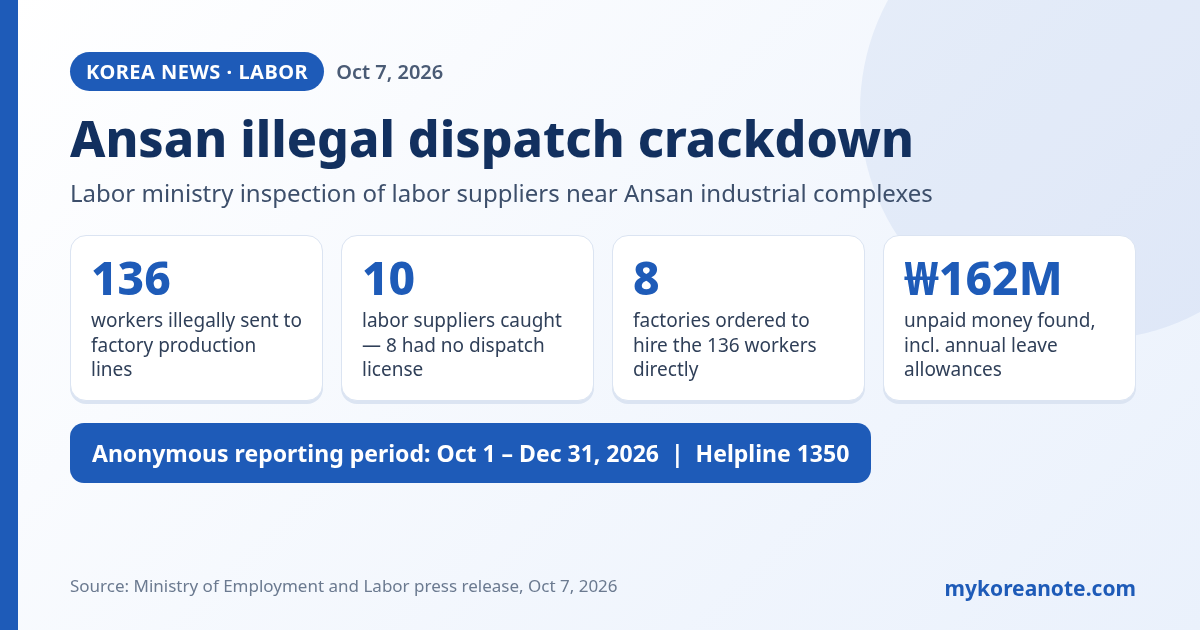
- The inspection started on June 22, 2026 and ran for about three months.
- It began with four unlicensed labor suppliers and two local manufacturers, then expanded to 19 workplaces in total.
- Ten labor suppliers were found to have sent a total of 136 workers to the direct production lines of eight manufacturers.
- Eight of those ten suppliers did not have a license to run a worker dispatch business.
- MOEL opened criminal investigations into the suppliers and ordered the eight manufacturers to hire all 136 workers directly.
- Inspectors also found 27 other labor law violations, including KRW 162 million in unpaid money such as annual leave allowances, and breaches of the overtime limit. Employers were ordered to fix them.
Why was this illegal? Under Korean law, sending dispatched workers to the direct production process of a manufacturer is banned in principle. It is allowed only in special situations, such as a sudden surge in orders. Running a dispatch business also requires a government license.
The inspection is not stopping in Ansan. MOEL is running an intensive reporting period from October 1 to December 31, 2026 to look at illegal labor suppliers in other industrial complexes, and it plans more inspections based on the tips it receives.
What this means for foreign workers
Ansan’s industrial areas are home to one of Korea’s largest foreign communities, and many people find factory jobs through labor agencies. The ministry did not say how many of the 136 workers were foreign nationals, but the lessons apply to everyone.
- Know who your real employer is. If an agency pays you but you work every day on another company’s production line, ask the agency whether it holds a dispatch license.
- E-9 workers, be careful. Under the Employment Permit System, you may work only at the workplace named in your employment permit. Changing workplaces must go through the official procedure at the Employment Center (Goyong Center), so ask there before you accept work somewhere else.
- Keep records. Save your contract, pay slips, bank deposits and notes of your working hours. These help if you are owed annual leave pay or overtime pay.
- You can report anonymously. On the Labor Portal (labor.moel.go.kr), go to the counseling and report center menu and choose the anonymous tip for illegal labor suppliers. You can also call the MOEL helpline at 1350 (weekdays, 9 a.m. to 6 p.m.).
If you are not sure whether your situation is legal, talk to your local Employment Center or a foreign worker support center before you sign anything new. Getting advice early is much easier than fixing a problem later.
This article is for general information only and is not legal advice.
Source: Ministry of Employment and Labor press release (Oct 7, 2026, in Korean)
Featured photo: Republic of Korea (Korea.net) / Wikimedia Commons, CC BY-SA 2.0 (cropped)