Korea Names 92 Depopulation Areas: What It Means for Regional Visas
South Korea has updated its official list of “depopulation areas” for the first time in five years. The list matters to many foreign residents, because Korea’s regional visa programs are tied to these areas. Here is what changed on October 7, 2026, and why it may affect your visa plans.
Key facts
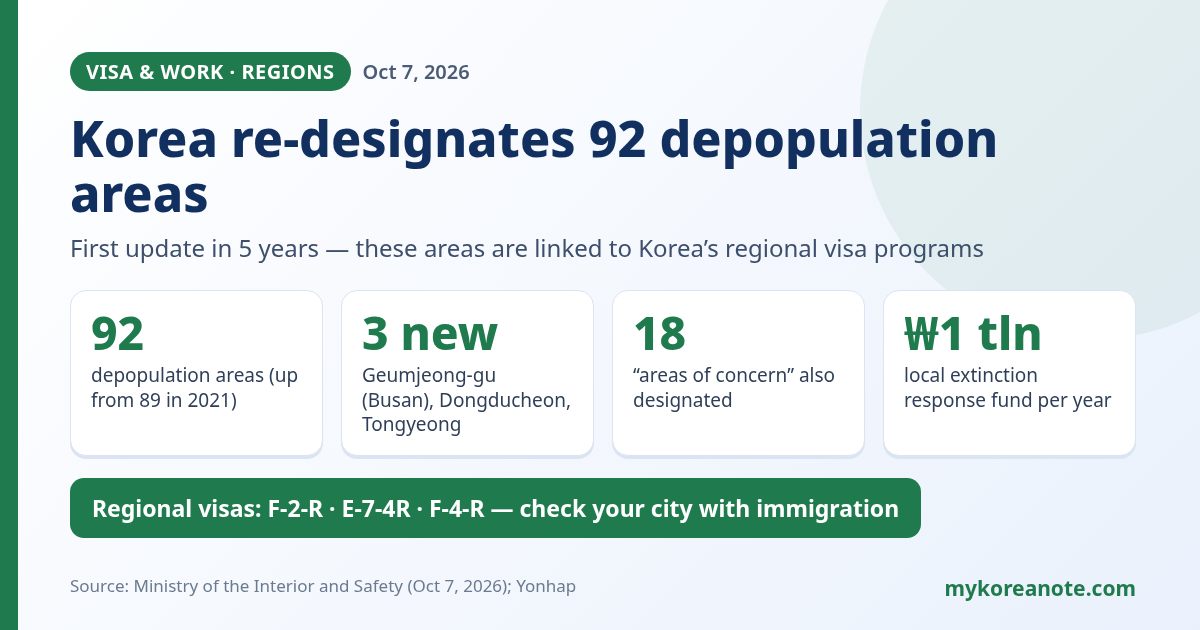
- The Ministry of the Interior and Safety re-designated 92 cities, counties and districts as depopulation areas, up from 89 when the list was first made in 2021.
- Three areas were newly added: Geumjeong-gu in Busan, Dongducheon in Gyeonggi Province, and Tongyeong in South Gyeongsang Province. All three were previously listed as “areas of concern”.
- The government also kept 18 “areas of concern” (places at risk of becoming depopulation areas). Busan’s Buk-gu, Yecheon and Chilgok in North Gyeongsang were named areas of concern for the first time.
- By province, the list includes 16 areas in South Jeolla, 15 in North Gyeongsang, 12 each in South Gyeongsang and Gangwon, 10 in North Jeolla, 9 in South Chungcheong and 6 in North Chungcheong.
- The new criteria use nine indicators. Alongside population change, aging and birth rates, they now include the urbanized-area ratio, the number of employed people and the “living population”.
- Areas whose situation has improved are classified as “Population Vitality+” areas and will keep receiving their existing support for five years. A local extinction response fund of about KRW 1 trillion a year supports these regions.
What this means for foreign workers
Korea uses depopulation areas as the map for several regional immigration programs. According to Ministry of Justice materials, the regional talent visa (F-2-R) and the regional ethnic Korean visa (F-4-R) target depopulation areas, while the regional skilled worker visa (E-7-4R) covers both depopulation areas and areas of concern. Since May 18, 2026, a pilot program also lets small manufacturers, shops, restaurants and farming corporations in depopulation areas hire one F-2-R worker even with no Korean employees, if they meet business-age and sales conditions. The pilot runs until December 31, 2027.
Practical tips:
- Living in Geumjeong-gu, Dongducheon or Tongyeong? Your area is now on the main list. Regional visa programs are run with local governments, and the Ministry of Justice has not yet said when the new list will apply to each program, so ask your local immigration office or city hall before planning around it.
- Planning an E-7-4 move? The 2026 K-point system gives bonus points for working in a depopulation area for a certain period. Check the latest HiKorea notice for how the updated list is counted.
- Already on a regional visa? These visas usually come with conditions about where you live and work. Do not move to another city without checking first, even if the new city is also on the list.
Visa rules change often. Always confirm with HiKorea or the immigration contact center (1345) before you apply.
Sources: Ministry of the Interior and Safety press release (Oct 7, 2026, in Korean); Yonhap News Agency (Oct 7, 2026); Korea.kr: regional small business hiring exception (in Korean)
Featured photo: Alain Seguin / Wikimedia Commons, CC BY-SA 3.0 (cropped)