
Factory “Vitamin Shots” Before Health Exams: What Foreign Workers Should Know About the DN Automotive Lead Case
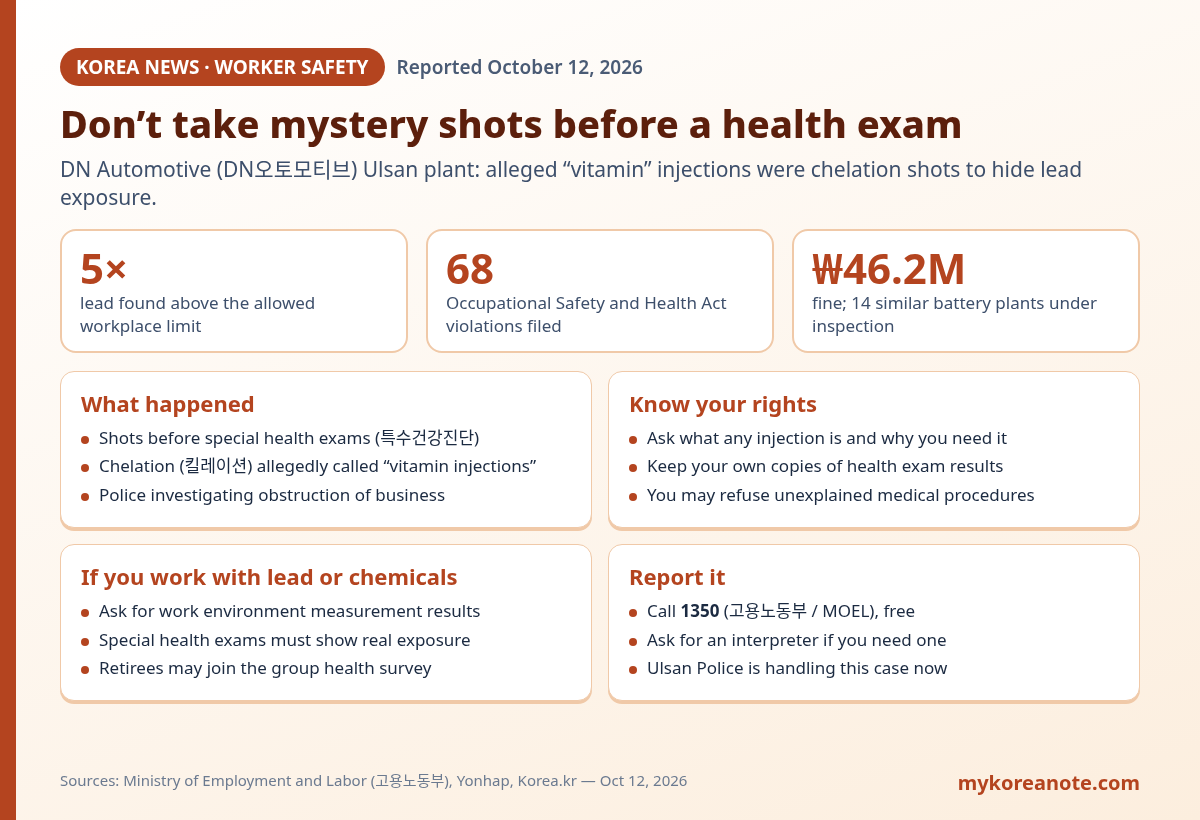
On October 12, 2026, President Lee Jae Myung ordered a stern response after reports that car-battery maker DN Automotive (DN오토모티브) at its Ulsan plant allegedly gave workers injections labeled as “vitamin shots” that were actually chelation (킬레이션) treatments meant to flush lead from the body before special health exams (특수건강진단). According to the presidential office, lead in the production process was found at more than 5 times the standard level, yet the plant passed its work-environment assessment. If you work in a factory with chemicals or metals, here is what this case means for you.
What authorities found
- MOEL received a tip at the end of January 2026, ran safety and health supervision from March 23 to April 17, and did precise work-environment measurements from March 31 to April 3.
- It filed and sent to prosecutors 68 violations of the Occupational Safety and Health Act (산업안전보건법) and imposed a fine of KRW 46.2 million (4,620만 원).
- It ordered the company to stop using the lead-exposure process from April 21 to May 7, and suspended the work-environment measurement agency’s business for 3 months (June 22 to September 21) after finding poor measurements.
- On August 13, MOEL referred the company to police for obstruction of business (업무방해), saying chelation shots before special health exams interfered with worker health protection. Ulsan Police is investigating.
- MOEL is expanding planned supervision and precise measurements to 14 similar battery manufacturing workplaces, and on October 8 launched a 9-person labor–management–government expert committee. Korea Occupational Safety and Health Agency (한국산업안전보건공단) will run a group epidemiological survey of current and former workers.
Why this matters for foreign workers
Many foreign workers in Korea work in manufacturing, including battery and metal plants. Special health exams exist so doctors can see if hazardous materials are harming you. If someone gives you a shot to lower metal levels in your blood right before the exam, the result may look safer than your real workplace exposure. That can hide danger and delay care.
What you should do
- Ask before any injection. Ask what the medicine is, why you need it, and whether it is linked to an upcoming health exam. You may refuse a procedure you do not understand.
- Keep your own records. Save copies of special health exam results (특수건강진단) and any work-environment measurement notices. Compare numbers year to year.
- Ask about lead and other hazards. You can ask your employer or safety manager for work-environment measurement results for your process.
- Report problems. Call 1350 (MOEL customer center). Ask for an interpreter if you need one. For immigration questions, call 1345.
- If you already worked there. Former workers may be included in the group health survey. Watch official notices from MOEL and KOSHA, or ask 1350 how to join if you were exposed.
DN Automotive posted an apology on October 12, saying it would cooperate with government investigations, expert health checks, and the improvement committee. The president called the alleged practice a grave human-rights violation and ordered checks for similar cases at other workplaces.
Top photo: a lead–acid car battery, via Wikimedia Commons (illustrative; not a photo of the DN Automotive plant).
Sources
- Korea.kr: President Lee orders stern response on heavy-metal injection case, Oct 12, 2026
- Yonhap (English): Lee orders stern response to alleged abuse at car battery plant, Oct 12, 2026
- Yonhap: MOEL refers DN Automotive to police for obstruction; 68 violations, KRW 46.2 million fine (Korean)
- Money Today: MOEL details on 68 violations, use-stop order, 14-plant expansion, Oct 12, 2026 (Korean)
- Yonhap: DN Automotive apology statement, Oct 12, 2026 (Korean)