
Korea’s New Student Visa Plan: Easier Rules for Good Korean, D-10 Stay of Up to 3 Years
Are you studying in Korea, planning to come here as a student, or about to graduate and look for a job? Korea’s Ministry of Justice has announced a big plan to change how student visas work. It covers the whole path: getting the visa, working part-time while you study, and staying in Korea after graduation. Here is what was announced on October 7, 2026, who it affects, and what you should do now.
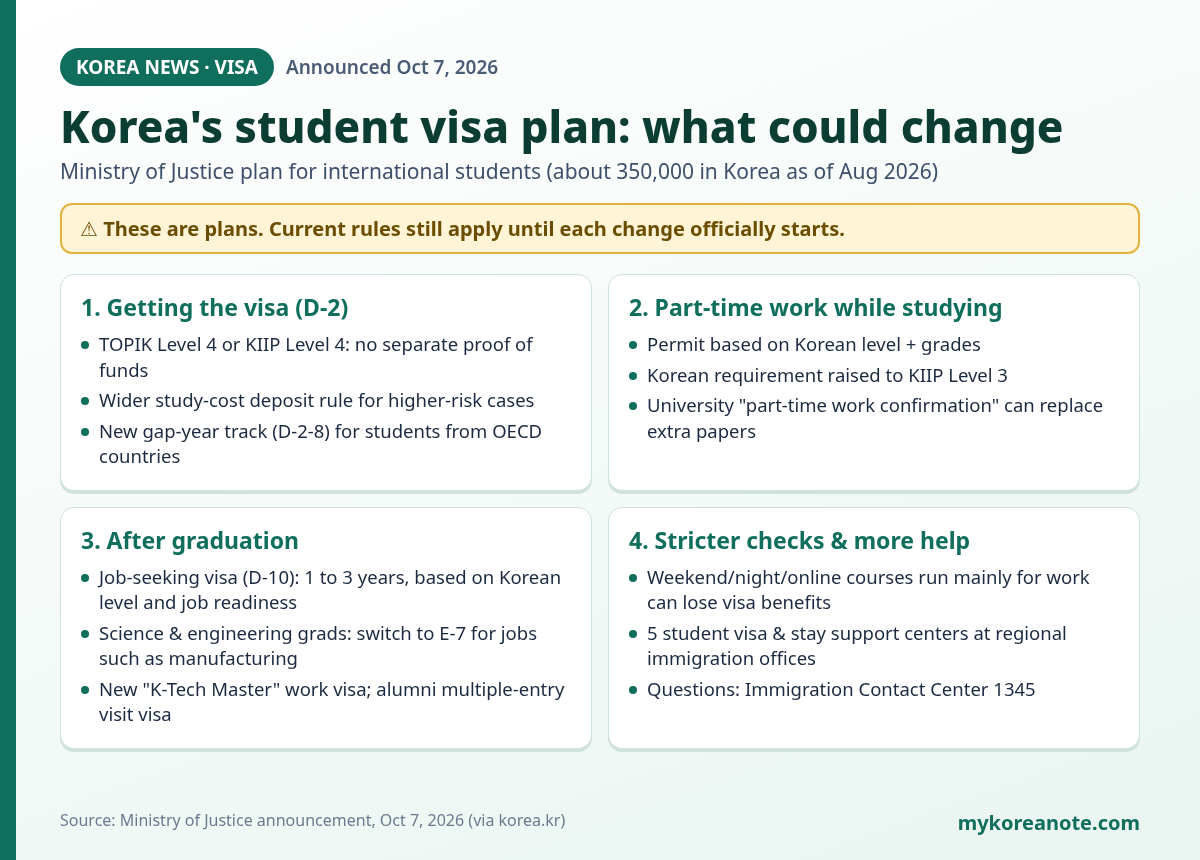
What happened
The Ministry of Justice’s Korea Immigration Service set up an advisory council (외국인 유학생 비자제도 개선 협의회) of university, education and immigration experts in April 2026. After about five months of discussion, the ministry released its results. The number of international students in Korea grew from about 200,000 in 2022 to about 300,000 last year and about 350,000 as of August 2026. The government says it now wants to focus less on simply bringing students in and more on helping good students study, find jobs and settle in Korea, while acting firmly against people who misuse student visas.
The main changes in the plan
1. Getting a student visa
- Good Korean = no separate proof of funds. Students with a certain level of Korean, such as TOPIK Level 4 (한국어능력시험 4급) or Level 4 of the Korea Immigration and Integration Program (KIIP) (사회통합프로그램 4단계), would not need to separately prove they can pay tuition and living costs.
- Deposit rule for higher-risk cases. For applicants who need closer checks because of a higher risk of overstaying or illegal work, the ministry will use a study-cost deposit system (유학경비 보증금제) more widely. Students must keep their study money in an account for a set period.
- New visa tracks. A “gap-year student” track (D-2-8) is planned for students from OECD countries who want to explore study and career options in Korea before university.
- Checks on agents and documents. The ministry will standardize how overseas school records are checked and plans a registration system for overseas study agencies.
2. Part-time work while studying
- The rules for a part-time work permit would be simplified so they focus mainly on your Korean level and your grades.
- At the same time, the Korean requirement would become stricter: KIIP Level 3 (사회통합프로그램 3단계).
- If your university issues a part-time work confirmation (시간제 취업 확인서), you would not need to submit extra documents.
- Weekend, night or online courses that are run mainly to let students work instead of study will be watched closely. Those departments can lose visa benefits, such as simpler paperwork, even if the university itself is certified.
3. After graduation
- The stay allowed on the job-seeking visa (D-10) would range from 1 to 3 years, depending on your Korean level and how ready you are for work.
- Science and engineering students who meet Korean language and other conditions could switch to the E-7 skilled worker visa for jobs in fields such as manufacturing.
- A new “K-Tech Master” work visa is planned for graduates of specialized technical master’s programs, with a path from study (D-2) to long-term residence (F-2).
- Graduates who have gone home could get a multiple-entry alumni visit visa (한국 유학 동문 방문비자) to visit Korea more easily.
- For students who want to start a tech business (D-8-4), universities will add courses linked to the OASIS startup program for foreigners.
4. More help with paperwork
- 5 student visa and stay support centers (유학생 비자·체류 지원센터) are planned at regional immigration offices, so students can handle visa matters in one place.
- An online guide will show step by step how to change your visa status, plus a checklist of requirements for each type of job.
- More immigration services will move online, so you visit offices and submit papers less often.
When does this start?
This is a plan, not a finished rule change. The ministry said the items it can change by itself will start from the second half of this year. Bigger items, and items that need agreement with other ministries, will be worked out later through government-wide talks. No exact start date was given for each item. Until a change officially starts, the current rules still apply.
Who is affected
- Students now studying in Korea on a D-2 student visa
- Graduates who plan to look for work in Korea (D-10) or switch to a work visa
- People overseas who plan to study in Korea, and their families
What you should do now
- Do not act on the plan yet. Follow the rules that apply today when you apply for, extend or change a visa.
- Study Korean and take the tests. Korean ability (TOPIK and KIIP levels) is at the center of almost every change in this plan, from the visa to part-time work and life after graduation.
- Only work part-time with permission. Check with your university’s international office before you take a part-time job. At a parliamentary audit of the Ministry of Justice on October 8, a lawmaker said 1,132 foreigners were caught working illegally in delivery jobs from January to August this year, and the ministry said it will prepare improvements.
- Ask official sources. For your own case, call the Immigration Contact Center at 1345 (외국인종합안내센터) or contact your university’s international office.
We will update this when the ministry announces exact dates for each change.
This article is for general information only and is not legal advice.
Sources: Ministry of Justice press release on korea.kr (Oct 7, 2026, in Korean); Money Today report on the Oct 8 parliamentary audit (in Korean)
Featured photo: Underwood Hall, Yonsei University, Seoul, by Tungdangthanh, via Wikimedia Commons, licensed under CC BY-SA 4.0 (cropped).
Pingback: Can Foreign Students Work as Delivery Riders in Korea? No: 1,132 Caught in 2026